
Publications
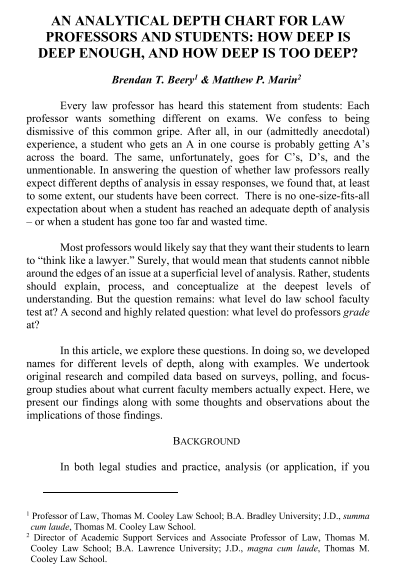
Matthew Marin & Brendan Beery, An Analytical Depth Chart for Law Professors and Students: How Deep Is Deep Enough, and How Deep Is Too Deep?, 39 T.M. Cooley L. Rev. 39 (Issue 1) (2024).
Every law professor has heard this statement from students: Each
professor wants something different on exams. We confess to being dismissive of this common gripe. After all, in our (admittedly anecdotal) experience, a student who gets an A in one course is probably getting A’s across the board. The same, unfortunately, goes for C’s, D’s, and the unmentionable. In answering the question of whether law professors really expect different depths of analysis in essay responses, we found that, at least to some extent, our students have been correct. There is no one-size-fits all expectation about when a student has reached an adequate depth of analysis – or when a student has gone too far and wasted time.
Click here to read more.
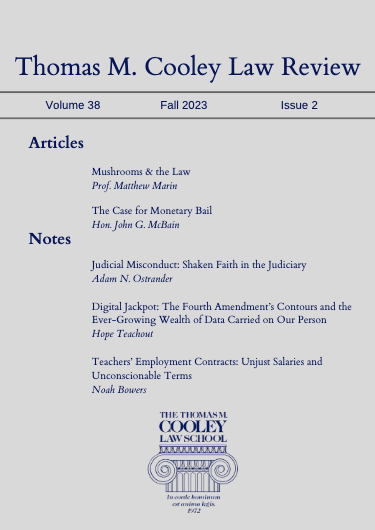
Matthew Marin, Mushrooms & the Law, 38 T.M. Cooley L. Rev. 1 (Issue 2) (2023).
Ah, the humble mushroom. It exists as a member of one of the five kingdoms of life. And they have been around for a long time. In fact, the first mushrooms are now thought to have evolved between 715 and 810 million years ago. Because they are such an old life form, many ancient cultures revered mushrooms. For example, the ancient Chinese called Reishi the mushroom of immortality, and it was only served to the Emperor of ancient China. And the Egyptians etched fungi into hieroglyphics depicting them as gifts from the gods sent to earth on lightening bolts. Even the Bible refers to fungi, stating that if mold if found in a home, a priest should go to that house and shut it up for seven days. Mushrooms are a species that we could not live without—they make plant life possible, and they also are responsible for keeping the world’s delicate environment balance in place. In addition, do you enjoy leavened bread or the occasional alcoholic beverage? Thanks, fungi! With that said, it is approximated that scientists have only discovered and categorized two percent of all the species of mushrooms that exist in our world. So with the prevalence of fungi, it should come as no shock that mushrooms have been at the center of litigation and other legal disputes, issues, and foci. Following are a few common-place and some not-so-common-place situations where mushrooms have proliferated in the legal field.
Click here to keep reading.
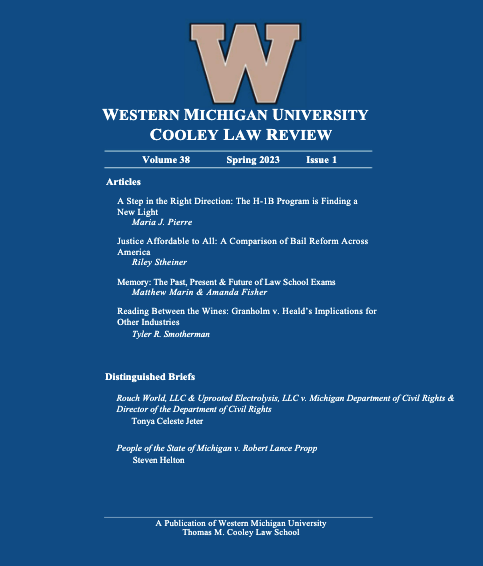
Matthew Marin & Amanda Fisher, Memory: The Past, Present & Future of Law School Exams, 38 W. Mich. U. T.M. Cooley L. Rev. 29 (2023).
Lawyers must have a basic understanding of the rules of law. To prepare students for practice, law schools must help students memorize copious amounts of law, concepts, and values, because memorization is ingrained in how licensure is measured. But do licensed attorneys actually practice based on the memorization of rules? Is the expectation to memorize and never consult and look up rules and authorities? In essence, does pure memorization of rules produce successful lawyers? Subsequent to the COVID-19 pandemic, many law schools transitioned online, and so did final examinations. Though some institutions had open-book exams pre-COVID-19, some did not. Because of the shift to the virtual world, most other law schools had to adapt and begin giving online (and in some cases untimed) final exams. As most law schools transition back to in person, it is back to closed book final examinations. But should it be that way?
Click here to read more.

Professor Marin has co-authored a comprehensive case book on Contract law. The book teaches important contract-law principles, including Multistate Bar Examination concepts, through the vehicle of all-Florida cases (with supplementation in cases where Florida has not addressed a major topic). In addition to the traditional case book, he has also co-created fill-in-the-blank chapter outlines and prequel videos to supplement law students’ in-class learning.
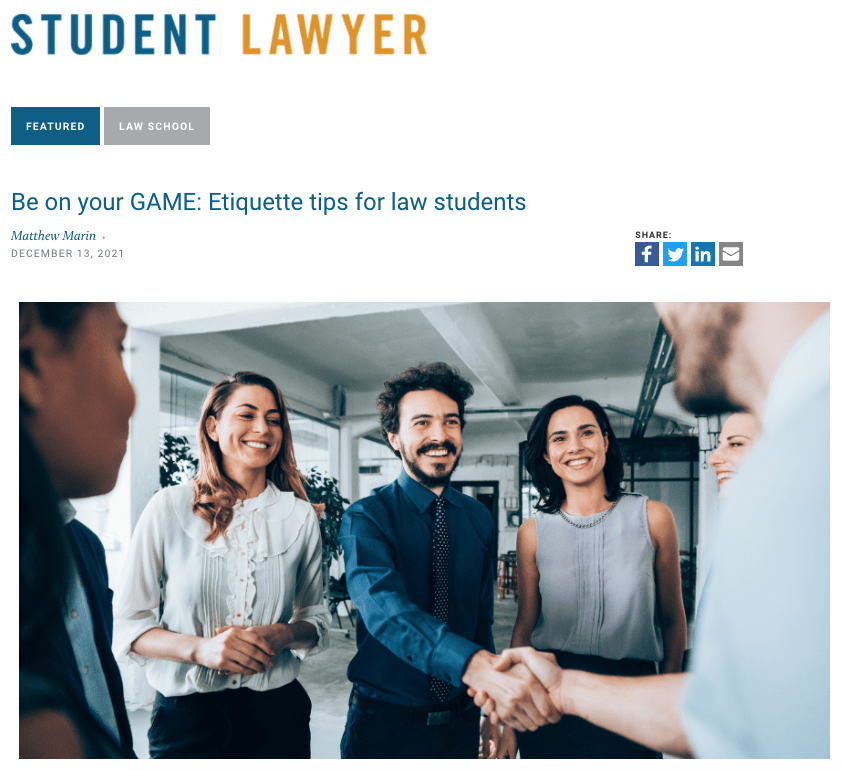
Be on Your GAME: Etiquette Tips for Law Students
The first recorded etiquette rules are traced to 2400 B.C., and many are still important today in the practice of law. So it goes without question that law students should learn, hone, and abide by basic etiquette guidelines. To narrow down the long list of rules, here are four main categories to prioritize: Greetings, being Ahead of Schedule, Meetings, and Emails. In other words, be on your GAME!

Asynchronous Teaching Methodologies: Pandemic Reflections and Best Practices
The COVID-19 pandemic forced legal education online. As a result, professors are holding classes using online synchronous, asynchronous, or a combination of methods. Professors have many choices to make when designing an asynchronous course, and a variety of tools that they can use in many different ways; therefore, professors who are new to the process may find it intimidating or overwhelming when trying to find “best practices.”

Leading with Compassion: Reflections on Post-COVID-19 Legal Education
The COVID-19 crisis sent education spiraling into the unknown. The
United States’ legal education system has been battling a unique situation
throughout the pandemic because law-school courses have largely relied on in-person, Socratic or modified-Socratic teaching methodologies since 1870.
For legal institutions that implemented online learning prior to COVID-19, course
offerings were generally limited to non-required courses.
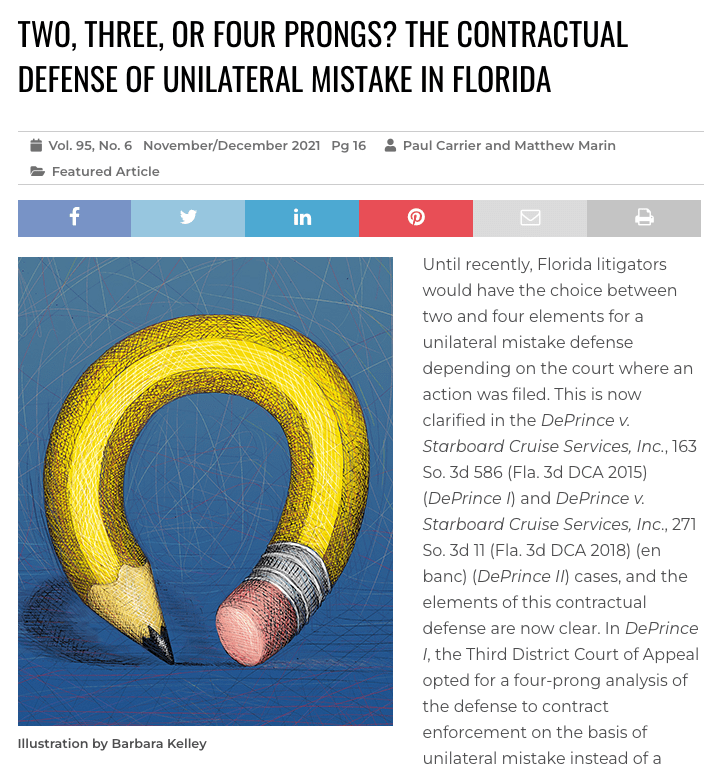
Two, Three, or Four Prongs? The Contractual Defense of Unilateral Mistake in Florida
Until recently, Florida litigators would have the choice between two and four elements for a unilateral mistake defense depending on the court where an action was filed. This is now clarified in the DePrince v. Starboard Cruise Services, Inc., 163 So. 3d 586 (Fla. 3d DCA 2015) (DePrince I) and DePrince v. Starboard Cruise Services, Inc., 271 So. 3d 11 (Fla. 3d DCA 2018) (en banc) (DePrince II) cases, and the elements of this contractual defense are now clear. In DePrince I, the Third District Court of Appeal opted for a four-prong analysis of the defense to contract enforcement on the basis of unilateral mistake instead of a three-prong analysis
Click here to read more.
Matthew Marin & Amanda M. Fisher, Wellness: Be Proactive!, Student Lawyer (May 16, 2022).
Matthew Marin & Jayson Thomas, All Humans Are Mortal: Syllogisms for Legal-Analysis Success, Student Lawyer (July 4, 2022).
Matthew Marin, Memorization Techniques for Law Students, Student Lawyer (September 14, 2022).
Matthew Marin & Amanda Fisher, Inclusion in Legal Writing: A Practitioner’s Guide, American Bar Association After the Bar (November 9, 2022).
Matthew Marin, Tips for Law Students on How to Send a Professional Email, Student Lawyer (December 12, 2022).
Matthew Marin & Tonya Krause-Phelan, The Lawyer’s Journey from Mentee to Mentor, The Young Lawyer (January 20, 2023).
Matthew Marin & Courtney Yonker, Twisting the Tale on Imposter Syndrome, Student Lawyer (January 27, 2023).
Matthew Marin, Etiquette Tips for Law Student Internships, Networking, and Social Events, Student Lawyer (July 18, 2023).
Matthew Marin, Ghosts, Spirits, and the Multistate Bar Examination, Student Lawyer (November 20, 2023).
Matthew Marin, How Law Students Can Use Templates to Write Successful Essay Responses, Student Lawyer (September 12, 2024).
Matthew Marin, A Step-by-Step to E-Filing and Pitfalls to Avoid, Student Lawyer (October 15, 2024).
Matthew Marin, Getting the MOST out of Managing the Law School Workload, Student Lawyer (October 24, 2024).
Matthew Marin & Kyndal Midkiff, How to Overcome the Anxiety of Cold Calling in Law School, Student Lawyer (November 22, 2024).
Matthew Marin & Katelyn Hearn, Essential Soft Skills You Must Develop During Law School, Student Lawyer (August 6, 2025).
Matt Marin & Brad Charles, Building Bar Skills: Sales (UCC) Module, AccessLex Institute (2025).
“Education is not preparation for life; education is life itself.”
John Dewey, Attributed

 Matthew Marin